
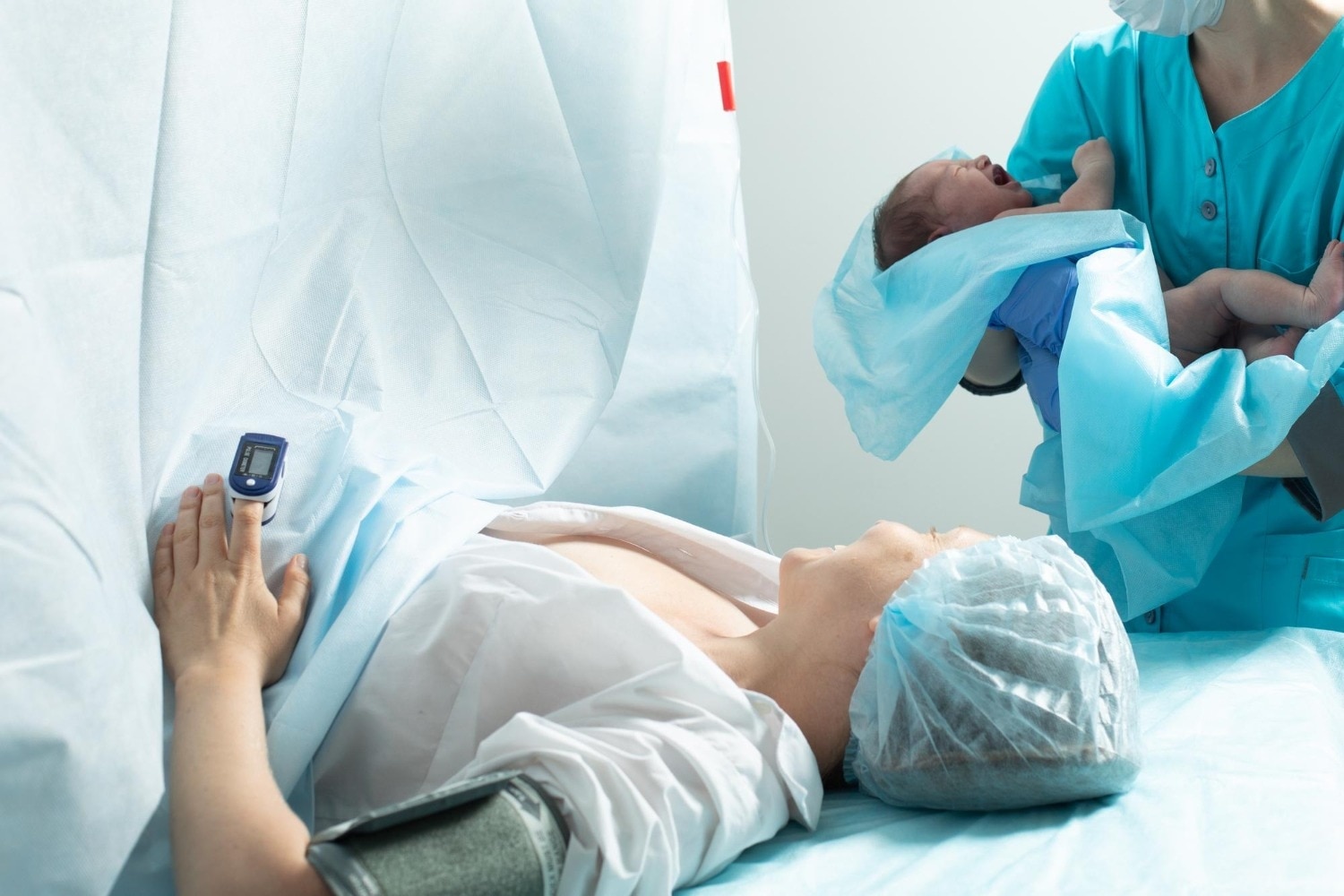
Labour pain relief can range from breathing support and movement to epidural analgesia, while a Caesarean section uses anesthesia for abdominal surgery and carries a different recovery. By the end, you will know how each option works, when a Caesarean is medically advised, what questions to ask a maternity unit, and how previous surgery affects planning.
Key takeaways
- Epidural analgesia reduces labour pain without making you unconscious.
- Caesarean birth uses spinal or general anesthesia for surgery, not an epidural alone.
- Ask whether an anesthetist, operating theatre, blood bank and newborn team are available.
- Compare recovery time, warning signs and follow-up before choosing a maternity unit.
What painless delivery involves in practice
“Painless delivery” usually means labour analgesia, not complete loss of sensation. Your options for labour pain relief in Nagpur can include:
- Continuous support, breathing and relaxation techniques, movement, position changes, massage, heat, and water immersion where available
- Intravenous medicines or inhaled nitrous oxide where offered
- Epidural analgesia or a combined spinal–epidural (CSE), which usually provide stronger relief than non-drug methods
For an epidural, an anesthetist cleans the lower back, inserts a needle between the spinal bones, and guides a thin catheter through it before removing the needle. Medicine passes through the catheter and is adjusted as labour changes.
It takes time to become effective, so staff check your blood pressure and monitor the fetal heart rate. The epidural mainly reduces pain while usually preserving awareness, pressure sensation, and your ability to participate in pushing.
Ask about an epidural early in labour; there is no universal cervical-dilation deadline. Staff availability, an urgent birth, infection near the insertion site, active bleeding, low platelets, a clotting disorder, or anticoagulant medicines can delay or prevent placement. Earlier discussion leaves time for assessment and consent.
Tell the anesthetist about bleeding problems, platelet results, blood thinners, and previous spine surgery. Relief can be uneven or incomplete, and the catheter may need replacement. Reduced mobility, temporary low blood pressure, itching, fever, difficulty urinating, and a urinary catheter are possible; a rare post-dural-puncture headache also requires review.
How epidural analgesia differs from Caesarean anesthesia
The method is not necessarily the same. A labour epidural provides analgesia, reducing pain while usually preserving awareness and pressure sensation; Caesarean birth needs a denser surgical block that prevents pain from abdominal surgery.
| Birth plan | Main anesthetic | What you experience |
|---|---|---|
| Vaginal labour | Labour epidural | Pain decreases; you usually remain awake and may push |
| Caesarean birth | Spinal anesthesia, an epidural top-up, or combined spinal–epidural | A dense numbness allows surgery; you usually remain awake and can meet your baby |
Spinal or combined spinal–epidural anesthesia is commonly used for planned Caesarean birth. General anesthesia may be required when neuraxial anesthesia is unsafe, cannot be placed in time, remains incomplete, or an urgent maternal or fetal emergency demands immediate delivery.
For anyone comparing labour pain relief in Nagpur, ask about these epidural trade-offs:
- Temporary low blood pressure, requiring blood-pressure checks and treatment
- Itching, fever, or difficulty urinating; a urinary catheter may be needed
- Reduced mobility during labour
- Uneven or incomplete relief, sometimes requiring adjustment or replacement of the catheter
- A rare post-dural-puncture headache
Before placement, the anesthetist should review your platelet count, clotting history, blood-thinning medicines, previous spine surgery, injection-site infection, and severe bleeding. Agree on the plan if the block fails. This discussion belongs in any plan for painless delivery and cesarean section in nagpur.
When clinicians recommend induction, vaginal birth, or Caesarean section
A search for painless delivery and cesarean section in nagpur should lead to a discussion of five paths, not an automatic operation. Spontaneous labour is reasonable when mother and baby are well; induction starts labour for a medical or pregnancy-related reason. Planned Caesarean is scheduled before labour, while emergency Caesarean responds to an immediate problem.
| Option | What it means | When it applies |
|---|---|---|
| Spontaneous labour | Labour begins without medication | Mother and baby remain well |
| Induction | Labour is started medically | Continuing pregnancy is less safe than delivery |
| Planned Caesarean | Surgery is arranged in advance | A known condition makes vaginal birth unsafe |
| Emergency Caesarean | Surgery follows urgent assessment | Labour or fetal/maternal condition deteriorates |
| VBAC attempt | Vaginal birth after previous Caesarean | The scar and current pregnancy support a safe trial |
Common reasons for Caesarean birth include:
- Placenta previa, selected abnormal fetal positions, or obstructed labour
- Fetal distress or other fetal compromise
- Failed induction, severe pre-eclampsia, or certain previous uterine surgeries
High-risk status alone does not require surgery. The decision depends on the specific condition, gestational age, examination, fetal assessment, and available expertise.
For VBAC, obtain the operative report. The previous uterine incision, number and reason for prior Caesareans, fetal position, and placenta location shape planning. A classical incision, previous uterine rupture, or some uterine operations can make planned VBAC inappropriate. Any attempt requires continuous assessment, anesthesia, newborn support, and immediate emergency Caesarean capability.
Comparing recovery, risks, and preparation for Caesarean birth
A Caesarean section is major abdominal surgery, not simply a painless form of delivery. After an uncomplicated vaginal birth, mobility usually returns sooner; surgery adds an abdominal incision, postoperative pain, wound care, restricted lifting, a urinary catheter, thrombosis prevention, and higher infection and bleeding risks.
| Option | Recovery | Main considerations |
|---|---|---|
| Uncomplicated vaginal birth | Usually shorter stay and faster mobility | Perineal pain or tearing can still occur |
| Caesarean birth | Generally longer hospital stay and recovery | Incision pain, limited lifting, catheter use, wound checks, and blood-clot prevention |
A previous Caesarean also affects later pregnancies: placenta previa and placenta accreta become more likely. If there is no medical indication, planned surgery is ordinarily not scheduled before 39 weeks.
For planned surgery, confirm these points before admission:
- Confirm the indication, sign informed consent, check anemia and other medical risks, review medicines, and complete anesthesia planning.
- Check fetal position and placenta location, discuss feeding plans and skin-to-skin contact, and ask how thrombosis prevention will be provided.
- Learn the discharge plan and seek urgent help for fever, worsening wound redness, heavy bleeding, chest pain, or shortness of breath.
When mother and newborn are stable, skin-to-skin contact and breastfeeding support can begin in theatre or recovery. Stability, anesthesia, infection-control needs, staffing, and emergencies determine the timing. Ask any provider about cesarean section maternity care in Nagpur with these practical details, not just the promise of painless delivery.
Questions to ask a Nagpur maternity unit before admission
Before admission, get clear answers about who is physically available during labour, including nights and weekends—not merely reachable by referral.
- Is an obstetrician present or immediately available?
- Is an anesthesiologist available for epidural placement and Caesarean anesthesia?
- Is a trained neonatal team, operating theatre, continuous fetal monitoring, blood storage, or transfusion service on site?
- Can the unit perform an emergency Caesarean at any hour, and what is the usual decision-to-surgery time?
- Which pain-relief methods are available 24 hours a day, including movement support, intravenous medicines, nitrous oxide, epidural, or combined spinal–epidural?
- Does epidural placement depend on an on-call anesthetist, and what happens if analgesia is incomplete or uneven?
Ask how the unit handles cesarean section maternity care in Nagpur rather than accepting “we arrange it” as an answer.
| Question | Why it matters |
|---|---|
| Emergency Caesarean timing | Delays affect care when fetal or maternal compromise develops |
| Blood and neonatal backup | Referral during severe bleeding or newborn distress adds time |
| Analgesia failure plan | A replacement epidural, spinal anesthesia, or another method may be needed |
Bring prior Caesarean or uterine-surgery reports, platelet and clotting results, medication lists—including blood thinners—and antenatal scans. A consultation with Dr AsthaMotwani Best Gynecologist Nagpur can match your medical history, birth preferences, anesthesia assessment, and the facility’s emergency capability before you compare painless delivery and cesarean section in Nagpur.
Related items
Painless Delivery Motherhood is inarguably the most beautiful phase in a woman’s life. View service → |
 | Gynecology Safe Normal Vaginal delivery and Cesarean Section For years, women who'd had a C-section were encouraged to skip vaginal deliveries altogether and schedule C-sections for all future births. View product → |
Frequently asked questions
What does painless delivery mean in practice?
Painless delivery usually means labour analgesia, especially an epidural, rather than complete loss of sensation. You remain awake and may feel pressure during contractions and birth.
How does an epidural differ from Caesarean anesthesia?
An epidural relieves pain during labour while allowing vaginal birth. A Caesarean section uses spinal, epidural top-up or general anesthesia to provide the surgical anesthesia required for abdominal delivery.
When is a Caesarean section recommended?
Clinicians recommend Caesarean birth when vaginal delivery presents greater risk, such as certain placenta, fetal-position, fetal-distress or labour-progress problems. The indication depends on your examination and pregnancy findings.
What should you ask a Nagpur maternity unit before admission?
Ask about 24-hour obstetric and anesthesia cover, epidural availability, emergency Caesarean response time, blood-bank access, newborn support, admission documents, recovery arrangements and follow-up care.
Related product
 | Gynecology obstetrics High Risk Pregnancy includes Diabebtes, High blood pressure, hypothyroidism, hyperthyroidism, recurrent abortions or miscarriages, previous fetal... View product → |
Keywords